


Page 25 - D850_broschuere
P. 25
| LANDSCAPE  | LANDSCAPE


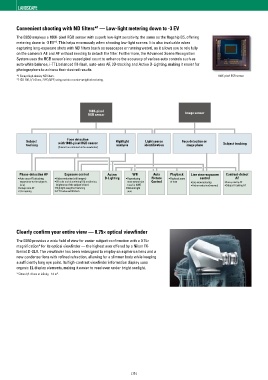
        Convenient shooting with ND filters*  — Low-light metering down to -3 EV
                                            1
        The D850 employs a 180K-pixel RGB sensor with superb low-light sensitivity, the same as the flagship D5, offering
                          2
        metering down to -3 EV* . This helps enormously when shooting low-light scenes. It is also invaluable when
        capturing long-exposure shots with ND filters (such as seascapes or running water), as it allows you to rely fully
        on the camera’s AE and AF without needing to detach the filter. Furthermore, the Advanced Scene Recognition
        System uses the RGB sensor’s increased pixel count to enhance the accuracy of various auto controls such as
        auto white balance, i-TTL balanced fill-flash, auto-area AF, 3D-tracking and Active D-Lighting, making it easier for
        photographers to achieve their desired results.
        *1 Except high-density ND filters.                                                        180K-pixel RGB sensor
        *2 ISO 100, f/1.4 lens, 20°C/68°F, using matrix or center-weighted metering.


                                        180K-pixel
                                        RGB sensor                                 Image sensor


                               Face detection
             Subject                                Highlight     Light source    Face detection on
            tracking       with 180K-pixel RGB sensor  analysis  identification     image plane     Subject tracking
                           (Cannot be confirmed in the viewfinder)


          Phase-detection AF  Exposure control   Active     WB       Auto    Playback  Live view exposure   Contrast-detect
         •Auto-area AF (attaching   •Flicker reduction (still images)  D-Lighting  •Reproducing   Picture   •Playback zoom   control  AF
          importance to the subject’s   •3D color matrix metering III (considering   more natural skin   Control   of face  •Live view metering  •Face-priority AF
 • Lens: AF-S NIKKOR 14-24mm f/2.8G ED • Exposure: [M] mode, 1.6 seconds, f/11 • White balance: Natural light auto • Sensitivity: ISO 64 • Picture Control: Auto   © Luke Austin  face)  brightness of the subject’s face)  tone for AWB  •Flicker reduction (movies)  •Subject-tracking AF
         •Group-area AF  •Highlight-weighted metering    •Natural light
         •3D-tracking    •i-TTL balanced fill-flash       auto
 More faithful color reproduction under natural light — New natural light auto white balance option

 The D850 employs a new “natural light auto” white balance mode, taking advantage of
 the Advanced Scene Recognition System’s improved light source identification function.
 This option delivers optimal white balance results under natural light — a valuable asset
 for landscape shooters. It makes it possible to respond quickly to changes in the weather
 conditions without switching to the direct sunlight or cloudy options. When shooting scenes   Clearly confirm your entire view — 0.75× optical viewfinder
 such as an autumnal landscape awash with red leaves or spectacular orange sunset, it also
 enhances the warm colors, helping create even more impressive pictures.  The D850 provides a wide field of view for easier subject confirmation with a 0.75×
        magnification* for its optical viewfinder — the highest ever offered by a Nikon FX-
        format D-SLR. The viewfinder has been redesigned to employ an aspherical lens and a
        new condenser lens with refined refraction, allowing for a slimmer body while keeping
 White balance: Auto 0  a sufficiently long eye point. Its high-contrast viewfinder information display uses
        organic EL display elements, making it easier to read even under bright sunlight.
 Preserve details in highlights and shadows — Active D-Lighting  * 50mm f/1.4 lens at infinity, -1.0 m . -1

 Even when shooting high-contrast scenes in backlit situations, Active D-Lighting preserves details in highlight areas as well as shadowy areas,
 reproducing brightness as you see it. Active D-Lighting is suitable for use with moving subjects, as it does not involve combining two images like
 the High Dynamic Range (HDR) function does.


 Produce amazing dynamic range — HDR

 The High Dynamic Range (HDR) function takes two images of different exposures with one shutter release and automatically combines them to
 produce a single image with a wider dynamic range. This achieves images with rich tonal gradation in shadows and highlights, even for high-
 contrast shooting scenes. HDR is ideal for stationary subjects such as high-contrast landscapes and still lifes.
 Note: Tripod use recommended.


 [ 24 ]                                                    [ 25 ]

