


Page 45 - D850_broschuere
P. 45
| COMMERCIAL SPORTS  | COMMERCIAL SPORTS


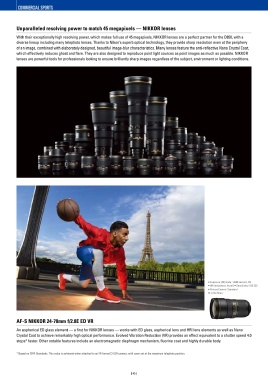
        Unparalleled resolving power to match 45 megapixels — NIKKOR lenses

        With their exceptionally high resolving power, which makes full use of 45 megapixels, NIKKOR lenses are a perfect partner for the D850, with a
        diverse lineup including many telephoto lenses. Thanks to Nikon’s superb optical technology, they provide sharp resolution even at the periphery
        of an image, combined with elaborately designed, beautiful image-blur characteristics. Many lenses feature the anti-reflective Nano Crystal Coat,
        which effectively reduces ghost and flare. They are also designed to reproduce point light sources as point images as much as possible. NIKKOR
        lenses are powerful tools for professionals looking to ensure brilliantly sharp images regardless of the subject, environment or lighting conditions.


 • Lens: AF-S NIKKOR 200mm f/2G ED VR II • Exposure: [M] mode, 1/640 second, f/2 • White balance: Color temperature (7690 K) • Sensitivity: ISO 6400 • Picture Control: Neutral   © Little Shao

 Truly dynamic action photography —
 Nikon FX-format, backside illumination CMOS   Backside illumination CMOS sensor  Conventional CMOS sensor
 sensor for 45.7 megapixels with ISO 64-25600  Micro lens  Micro lens
 Color filter  Color filter
 The D850 allows commercial sports   Photodiode  Circuitry
 photographers to capture moments   Circuitry  Photodiode
 of dynamic action in sumptuously rich
 detail — even during 9-fps continuous
 shooting. It is the first Nikon D-SLR to
 use a backside illumination sensor,
 which allows incoming light to reach photodiodes more efficiently.
 Together with the camera’s low-noise performance, this enables
 it to achieve ISO 25600 despite its high pixel count. What’s more, it
 strikes an optimal balance between sensor sensitivity and the volume
 Optical filter with

 of light information accumulated in photodiodes, yielding images   Optical filter without    Image sensor  low-pass filter layer  Image sensor
 low-pass filter layer
 with a wide dynamic range even at ISO 64 (expandable to ISO 32                              • Exposure: [M] mode, 1/800 second, f/8
 equivalent) — the lowest native ISO setting offered by any camera   Because the D850’s image sensor is designed without an optical low-pass filter (OLPF),   • White balance: Auto 0 • Sensitivity: ISO 320
                                                                                             • Picture Control: Standard
 manufacturer. Copper wiring is used to cut electrical resistance,   the light arrives at the sensor directly, delivering higher resolution.   © Little Shao
 while the backside illumination structure allows a flexible wiring
 layout, reducing stray capacity. These measures enable 45-megapixel   MTF chart
 FX-format images to be captured at continuous shooting speeds of   Without OLPF
 With OLPF
 9 fps* . And because the sensor is designed without an optical low-
 1
 pass filter, it can harness the sharpness of 45 megapixels when   MTF  AF-S NIKKOR 24-70mm f/2.8E ED VR
 combined with the high resolving power of NIKKOR lenses. The D850
 yields pictures that can be enlarged as massive prints at up to A2   An aspherical ED glass element — a first for NIKKOR lenses — works with ED glass, aspherical lens and HRI lens elements as well as Nano
 size*  or used for 8K digital signage displays.  Crystal Coat to achieve remarkably high optical performance. Evolved Vibration Reduction (VR) provides an effect equivalent to a shutter speed 4.0
 2
 lines/mm  stops* faster. Other notable features include an electromagnetic diaphragm mechanism, fluorine coat and highly durable body.
 *1 When using the optional MB-D18 Multi-Power Battery Pack with the EN-EL18b/EN-EL18a   • This is a conceptual graphic of an f/5.6 aberration-free lens.
 Rechargeable Li-ion Battery.
 *2 When printed at 300 dpi.
        * Based on CIPA Standards. This value is achieved when attached to an FX-format D-SLR camera, with zoom set at the maximum telephoto position.


 [ 44 ]                                                    [ 45 ]

