


Page 18 - D850_broschuere
P. 18
| LANDSCAPE                                                                                                            | LANDSCAPE


                                                                                                                               Effective noise reduction, fine detail and color reproduction with powerful image processing — EXPEED 5

                                                                                                                               Beauty is where you find it. The D850 captures it all — thanks to its EXPEED 5 image-processing engine, also
                                                                                                                               incorporated in the flagship D5. EXPEED 5 renders delicate tonality in highly vivid colors, and its superb noise reduction
                                                                                                                               suppresses noise effectively while maintaining detail. Its powerful calculation ability also permits high-speed
                                                                                                                               continuous shooting at approx. 9 fps* with 45 megapixels, as well as full-frame, 4K UHD movie recording.
                                                                                                                               * When using the MB-D18 Multi-Power Battery Pack with the EN-EL18b/EN-EL18a Rechargeable Li-ion Battery. The D850 shoots at 7 fps with the EN-EL15a/EN-EL15.


                                                                                                                               Create your ideal images — Picture Control system
                                                                                                                               Nikon’s Picture Control system helps you craft images that match your creative intentions and purposes. The D850 incorporates
                                                                                                                               the new Auto Picture Control, in addition to the seven existing presets. Each preset allows you to tune settings such as
                                                                                                                               sharpening and clarity, opening up a wider range of options for achieving your ideal image. You can adjust settings and store
                                                                                                                               them as your own custom Picture Controls.


                                                                                                                               Automatically adjust images to fit the scene — Auto Picture Control

                                                                                                                               Auto Picture Control produces more desirable images by automatically fine-tuning the tone curve, color, sharpening and clarity of the Standard
                                                                                                                               option, according to each scene’s characteristics. As a result, blue skies and verdant greens are rendered more vibrantly for landscape shots.
                                                                                                                               The Advanced Scene Recognition System is now even better at identifying light sources, meaning red colors can be emphasized in sunsets and
                                                                                                                               sunrises.


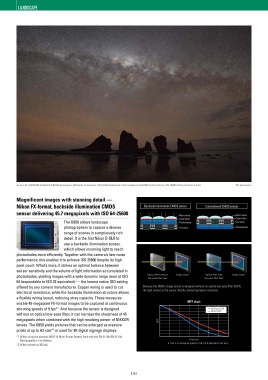
        • Lens: AF-S NIKKOR 14-24mm f/2.8G ED • Exposure: [M] mode, 15 seconds, f/2.8 • White balance: Color temperature (3700 K) • Sensitivity: ISO 10000 • Picture Control: Auto   © Luke Austin

        Magnificent images with stunning detail —
        Nikon FX-format, backside illumination CMOS              Backside illumination CMOS sensor  Conventional CMOS sensor
        sensor delivering 45.7 megapixels with ISO 64-25600                      Micro lens               Micro lens
                                                                                 Color filter             Color filter
                             The D850 allows landscape                           Photodiode               Circuitry
                             photographers to capture a diverse                  Circuitry                Photodiode
                             range of scenes in sumptuously rich
                             detail. It is the first Nikon D-SLR to
                             use a backside illumination sensor,                                                               Picture Control: Auto                                   Picture Control: Standard
                             which allows incoming light to reach                                                              • Lens: AF-S NIKKOR 70-200mm f/2.8E FL ED VR • Exposure: [A] mode, 1/125 second, f/8
        photodiodes more efficiently. Together with the camera’s low-noise                                                     • White balance: Natural light auto • Sensitivity: ISO 64  © Luke Austin
        performance, this enables it to achieve ISO 25600 despite its high
        pixel count. What’s more, it strikes an optimal balance between
        sensor sensitivity and the volume of light information accumulated in
                                                                                            Optical filter with

        photodiodes, yielding images with a wide dynamic range even at ISO   Optical filter without    Image sensor  low-pass filter layer  Image sensor
                                                                   low-pass filter layer
        64 (expandable to ISO 32 equivalent) — the lowest native ISO setting
        offered by any camera manufacturer. Copper wiring is used to cut   Because the D850’s image sensor is designed without an optical low-pass filter (OLPF),
        electrical resistance, while the backside illumination structure allows   the light arrives at the sensor directly, delivering higher resolution.
        a flexible wiring layout, reducing stray capacity. These measures
        enable 45-megapixel FX-format images to be captured at continuous           MTF chart
        shooting speeds of 9 fps* . And because the sensor is designed                         Without OLPF
                           1
                                                                                               With OLPF
        without an optical low-pass filter, it can harness the sharpness of 45
        megapixels when combined with the high resolving power of NIKKOR   MTF
        lenses. The D850 yields pictures that can be enlarged as massive
        prints at up to A2 size*  or used for 8K digital signage displays.
                         2
        *1 When using the optional MB-D18 Multi-Power Battery Pack with the EN-EL18b/EN-EL18a
          Rechargeable Li-ion Battery.                                               lines/mm
        *2 When printed at 300 dpi.                                        • This is a conceptual graphic of an f/5.6 aberration-free lens.


                                                           [ 18 ]                                                                                                                 [ 19 ]

